Artificial Intelligence
What Europe's AI gigafactory plan can and cannot buy
Europe's €30 billion AI gigafactory tender can fund useful compute. Its scale, energy, demand, and control constraints show what a sovereign AI strategy still requires.
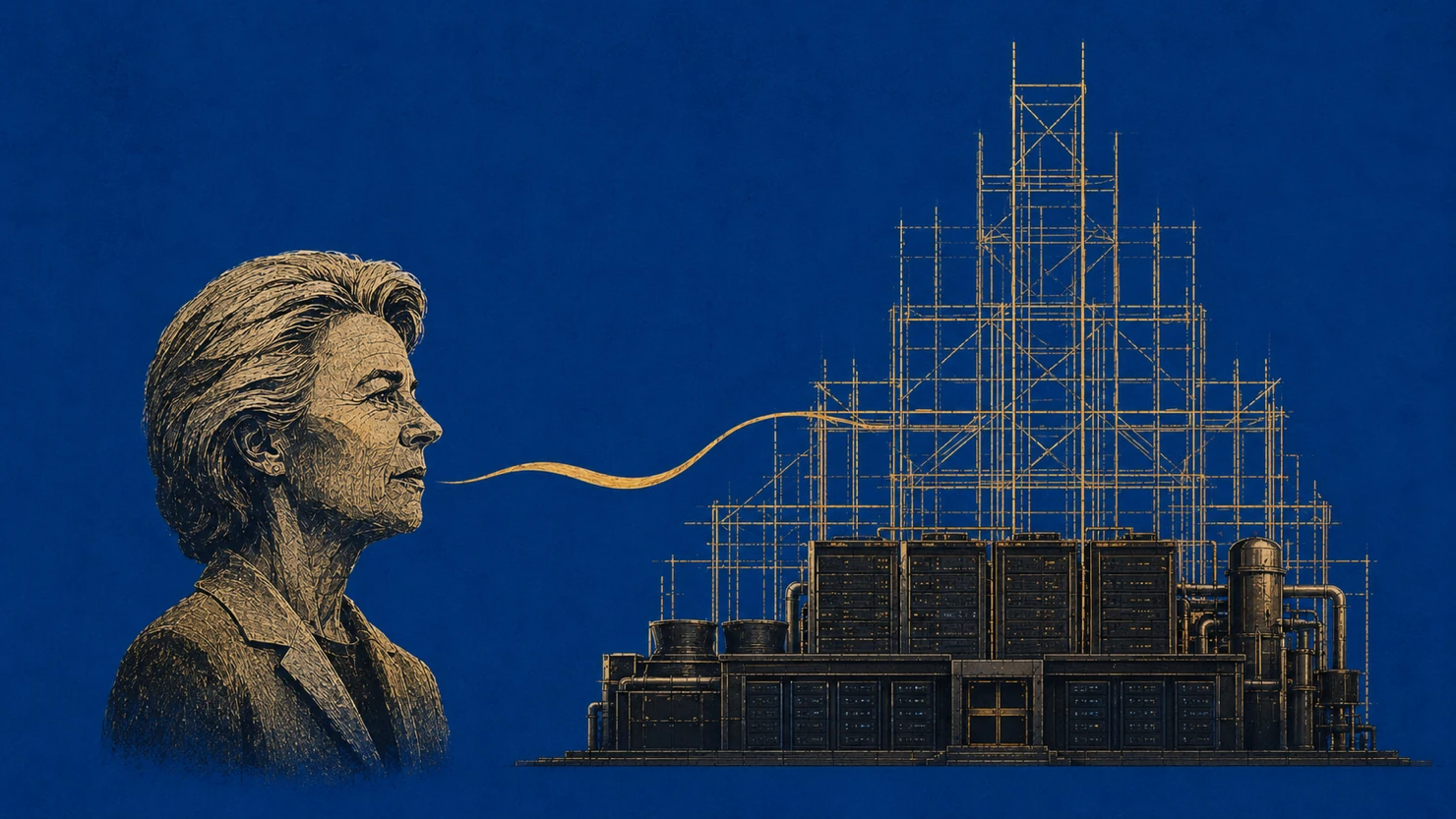
The short version
- The EU’s 30 July tender can partly fund useful compute, but it is nowhere near a continental AI strategy. Its headline package, up to €10 billion public and €20 billion hoped-for private across seven AI gigafactories, is about what Amazon, Alphabet, Microsoft and Meta now expect to spend on capital investment in seventeen days. The public share is just under six days.
- What I believe to be the investment case starts with a €100 billion sovereign-compute floor. A 10–20 GW European ambition, priced at the current $35–60 billion per frontier gigawatt, produces an upper scenario of roughly €304 billion to €1.04 trillion. That ceiling comes from realistic capacity and cost, not from borrowing a dramatic number from the Draghi report.
- Money alone will not do it. Europe also needs unified capital markets, coherent energy policy, faster deployment, better equity and talent rules, and investment in the labs and products that will use the compute. Sovereignty does not require autarky, but it does require enough control and exit capacity that hospitals, courts and companies are not trapped behind someone else’s chips, APIs or laws.
On 30 July, the European Commission opened bidding for something it had been promising for a year and a half: up to seven "AI gigafactories," backed by up to €10 billion of public money and intended to draw at least €20 billion more from private investors, for a headline package above €30 billion.1
Ursula von der Leyen announced it on X in moon-shot language:2
“Europe wants to become the first AI Continent.”
I replied and commented because Europe is my home, because I want it to win, and because the number looked tiny beside the stated goal.3 That reply was simple, but it gathered some feedback, which led me to do a deeper analysis and lose a night of sleep.
The tender is real policy, and its public-private structure does make sense. It can buy useful compute. However, it cannot buy the "AI Continent" promised in the speech.
I still agree with the ambition. I do not think this instrument is large, complete or sophisticated enough to deliver it.
What was actually announced, and what wasn't
The mechanics run through the EuroHPC Joint Undertaking. Bidding for up to seven large compute campuses closes on 12 November 2026, award decisions are expected in early 2027, construction is meant to begin that year, and the first sites are supposed to be operating around mid-2028.4
In the Commission's initial June 2025 count, an earlier round drew 76 expressions of interest across 60 sites in 16 member states, with respondents foreseeing at least three million specialized processors. The submissions indicated more than €230 billion of possible investment over three to five years.5
But this €230 billion is not committed money. These were non-binding submissions rather than formal applications, and they tell us nothing yet about which projects are financeable.
But what's interesting to me is that a possible pipeline nearly eight times larger than the eventual tender is useful evidence. So, clearly, the private appetite exists. Now Brussels has to identify the bankable projects, find out who will use them, and decide whether its instrument can move quickly enough to turn the best proposals into operating capacity.
The first obvious dependency is hardware. In the name of "technological sovereignty," the Commission signed letters of intent with AMD, Nvidia and Qualcomm to give consortia "seamless access to necessary hardware."6 That's reasonable given that Europe may have no alternative at frontier scale today. However, it is still financing greater operating independence with chips supplied by foreign firms.
The money behind the headline
Only around €1 billion of the €10 billion public share is committed from the current EU budget.
The rest depends on the next Multiannual Financial Framework (MFF), which has not been agreed. A senior Commission official described €30 billion as the best estimate of what might become available, rather than money already in hand.7 Large EU programs often bridge seven-year budget cycles, so future money does not make the program fictitious. It does make the timing awkward because AI companies invest quarter by quarter while the Union budgets seven years at a time.
A kind observer might say this is long-term planning. A more cynical one would draw parallels with long-gone failed unions and states in Central and Eastern Europe, and with their planned economies and five-year budgets.
But I digress.
Brussels had also announced more. At the Paris AI Action Summit in February 2025, von der Leyen launched InvestAI with a dedicated €20 billion gigafactory fund.8 Eighteen months later, the tender offers up to €10 billion public, roughly half from Brussels and half from participating states. Euronews reports that the Commission reduced its financial commitment as the initiative was delayed.9 The public number did not grow with the ambition. It was cut in half.
How the public-private split works
The tender is meant to draw in private investment rather than put Brussels in charge of construction. Under the binding regulation, the EU may cover up to 17% of eligible computing-infrastructure capital expenditure, and participating states must at least match that contribution. The private consortium pays the remainder and all operating costs. In the standard matched case, public support is about one third.10 Public money can cover processors, memory, storage, networking, racks, dedicated cooling and software. It does not cover the physical data center building or general site utilities.
The gigafactories are not an isolated initiative. They also sit above a network of smaller AI Factories.
The Commission says combined EU and participating-country investment in supercomputing infrastructure and AI Factories will reach €10 billion over 2021–2027. Its 2026 reporting attributes about €2.6 billion to the 19 AI Factories and 13 antennas selected so far.11 The first figure covers a seven-year program, while the second refers to the network selected so far.
Together they show that Europe has built machinery through EuroHPC and knows how to use public money to attract private capital. However, the funding remains far below the scale implied by the goal.
This program funds infrastructure. The EU AI Act governs how AI may be built and deployed, while the gigafactory tender pays for compute. Regulation matters later in the argument, but it is a separate instrument, and I wanted to bring it up early.
Seventeen days of hyperscaler spending
For the calculations below, I convert at €1 = $1.15, the market rate on the day of writing.12 I use ranges where sources disagree. All sources were retrieved on July 31, 2026, with retrieval dates recorded in the references.
The American run rate
At the reporting cut on 30 July, Amazon, Alphabet, Microsoft and Meta were guiding to roughly $720–745 billion of combined 2026 capital expenditure, about 76–82% above their roughly $410 billion of actual 2025 capex.13
Amazon expects to spend about $220 billion, and Alphabet guides to $195–205 billion. Microsoft's reported figure is about $175 billion after a lease-accounting change, while Meta expects $130–145 billion.14 Microsoft says the accounting change does not alter the underlying investment expectation, previously stated at about $190 billion. I use the lower reported figure to keep the aggregate conservative. Analysts now put broader 2027 capex above $1 trillion.15
That works out to about $2 billion a day.
Europe's whole €30 billion package, including the private money it hopes to attract over several years, converts to about $34.5 billion. The four companies expect to spend that much in roughly seventeen days.
The €10 billion public share is equivalent to about 5.6–5.8 days. For another check on the scale, Epoch AI counted $448.3 billion of total 2025 capex across five large technology companies, including $140.6 billion in the fourth quarter alone.16 Financial-press aggregations of current 2026 guidance also clear $700 billion.17
Some of that American spending does land in Europe.
For example, AWS switched on its €7.8 billion European Sovereign Cloud in Brandenburg in January 2026, and Microsoft has pledged tens of billions of dollars to expand European capacity.18
That capacity is useful. However, locating it in Europe does not create European ownership of the stack or remove every exposure to American law.
Another initiative is OpenAI's Stargate program, targeting $500 billion and 10 gigawatts of compute. Its flagship Abilene campus is heading toward about 1.2 GW. OpenAI and Nvidia were also reported in late July 2026 to be discussing a single roughly $500 billion, 10-GW site in Ohio.19
Just that single program is around fifteen times the size of Europe's seven-gigafactory envelope, while one contemplated site could exceed the European plan many times over.
Those American numbers need discounting and reality-checking too.
Stargate's $500 billion is a pledge, and reporting through 2025 and 2026 describes a joint venture that never staffed up, missed its 10-GW contracting target, and was bypassed by separate OpenAI deals.20 The Ohio site is still a discussion, and 2026 company figures are guidance rather than booked spending. But four companies did record about $410 billion of total corporate capex in 2025, while roughly €1 billion is currently committed to the EU's flagship gigafactory instrument.
So, with this in mind, I am not claiming every hyperscaler dollar bought an AI chip. What I am doing is comparing how much capital each side can mobilize.
What Europe has promised in total
But Europe's announcements add up to more than the tender.
InvestAI aims to mobilize €200 billion, including €150 billion in private pledges from the EU AI Champions coalition.21
France separately announced €109 billion of private AI investment at the same Paris summit, anchored by a UAE-backed gigawatt data center campus and Brookfield's €20 billion.22 If I count every announcement and generously ignore possible overlap, the stack reaches about €309 billion over five years, or roughly $71 billion a year at the exchange rate used here.
The four US companies' current guidance is still 10.1–10.5 times larger. Delivery matters as well. By May 2025, Macron was citing about €20 billion of projects delivered after the February pledges.23
Scroll horizontally to read the full comparison
| Figure | What it measures | Status |
|---|---|---|
| More than €30B | Seven-gigafactory tender envelope | Up to €10B public plus at least €20B sought from private consortia, spread over years |
| More than €230B | Initial 76 expressions of interest over three to five years | Indicative and non-binding, with no projects selected or financed yet |
| About €300B | Commission estimate for data center expansion plus cloud and AI initiatives | Broad public-private need through 2036, not a gigafactory budget |
| $720–745B | Amazon, Alphabet, Microsoft and Meta 2026 corporate capex | Company guidance that is infrastructure-heavy without being a pure AI total |
| About $410B | The same four companies' 2025 corporate capex | Actual spending, again broader than AI alone |
China's chip fund
And then there's China.
Its $47.5 billion (344 billion yuan) "Big Fund III" began deploying at the end of 2024 and covers the semiconductor layer rather than the full compute build-out.24 Cheaper open-weight models such as DeepSeek or Kimi have also spread globally. A full accounting of China's state-guided compute spending is beyond this essay's scope, but the chip fund alone is larger than the EU's public gigafactory commitment.
What €30 billion buys at current costs
A gigawatt of data center capacity is the useful unit here.
Current estimates range from roughly $35 billion to $60 billion per frontier gigawatt. Bernstein is near $35 billion, Epoch AI around $38 billion, and Nvidia's Jensen Huang has used $50–60 billion. Huang's $80–100 billion estimate describes where costs may be heading, so I do not use it for the main calculation.25 Citigroup uses about $50 billion and projects 55 GW of new AI power demand globally by 2030.26
At the current $35–60 billion band, €30 billion corresponds to roughly 0.58–0.99 GW of full-system cost. If the forward estimate reaches $100 billion, the same package buys about 0.35 GW. Even that comparison gives the headline more purchasing power than the regulation does, because eligible public CAPEX covers the compute system but excludes the physical building and general site utilities.
For scale on the chip side: Nvidia's data-center revenue was a record $75.2 billion in a single quarter (Q1 FY2027, ended April 2026), up 92% year-on-year, on full-year FY2026 revenue of $215.9 billion.27 Europe's entire public gigafactory check is about two weeks of Nvidia's data-center sales.
Stargate is targeting 10 GW, and the four US hyperscalers are collectively building toward many tens of gigawatts. At today's costs, Europe's current package does not finance one full frontier gigawatt.
Private investors have already tested part of this proposition in the wider European market.
Stargate Norway was announced on 31 July 2025 as a campus in Kvandal, outside Narvik, targeting 100,000 Nvidia GPUs and 230 MW of hydropower-fed capacity. It could expand toward 520 MW, with Nscale and Aker committing roughly $1 billion to the initial phase.28 During the year between that announcement and Brussels' tender, OpenAI stepped back after failing to conclude terms with Nscale, Microsoft contracted more than 30,000 next-generation Nvidia Rubin GPUs there from 2027, and OpenAI abandoned parallel UK plans with Nscale, reportedly citing regulation and energy prices.29
Neither Norway nor post-Brexit Britain is in the EU, so these cases do not prove that EU regulation caused the decisions. They say something about operating economics in the wider European market, including power prices, permitting time and commercial terms. The EU-specific evidence appears later in the Digital Omnibus postponement and the deployment examples. Europe also has strong candidate regions, especially France and the Nordics, which is why a serious siting analysis must compare locations rather than treat the continent as one grid.
Europe's own cap table
Mistral AI raised a €1.7 billion Series C in September 2025, led by ASML, at an €11.7 billion valuation. It was later reported to be discussing a round near €20 billion.30 Of course, a paper valuation cannot pay for servers. What it shows is how private investors rank the opportunity: they priced one European lab above the public commitment to seven gigafactories.
Lovable, the Swedish AI-coding company, reached a reported $6.6 billion valuation in December 2025 and was later reported to be raising near $12 billion.31 (Disclosure: I was very early at Lovable. I now research AI and work in the field, including as a consultant.)
Hugging Face, which was founded in France, was last publicly marked around $4.5 billion in a 2023 round.32 ASML, without whose equipment the most advanced chips cannot be made, is itself among Europe's most valuable technology companies.
The talent and companies exist, and private investors are willing to back them. But Europe is still struggling to turn that confidence into infrastructure and into companies that remain here as they scale.
Brussels' own numbers are already larger
Mario Draghi's September 2024 report put Europe's additional investment need at €750–800 billion per year, around 5% of EU GDP.33 Later estimates widened the overall strategic need toward €1.2 trillion per year. Progress has been slow. EPIC's first audit found 43 of 383 recommendations, or 11.2%, fully implemented in September 2025. Its January 2026 update reached 15.1%.34 These figures cover the whole economy rather than an AI infrastructure budget.
The Commission now provides a more relevant benchmark. Its June 2026 technology-sovereignty work estimates that expanding European data center capacity will require around €200 billion by 2036, mostly from the private sector, plus another €100 billion for cloud and AI leadership initiatives that include AI Factories and Gigafactories.35 This is a broad estimate of public and private infrastructure needs, not €300 billion reserved for gigafactories. Even so, Brussels' own assessment is an order of magnitude above the tender's headline envelope.
I do not take the €1 trillion ceiling from Draghi. I derive it later by multiplying 10–20 GW of capacity by the current $35–60 billion cost band. Draghi supplies context because his digitization slice alone was roughly €150 billion a year. The Commission's newer €200 billion plus €100 billion estimate also makes a €100 billion floor look conservative.
I am not arguing that AI should jump the queue ahead of defense (!!!), health or housing. Draghi's total covers the competitiveness gap across sectors, and the digital layer increasingly supports the others.
My argument is narrower. If Europe calls AI strategic, its funding and reforms should go beyond a moon-shot tweet from Ursula von der Leyen and match that scale.
Sovereignty means control and an exit
If Europe rents its AI from American clouds and Chinese labs, the practical risk is dependence on another jurisdiction's decisions. We got a recent taste of that when the US government ordered Anthropic to deny foreign nationals access to Fable 5 and Mythos 5. Because Anthropic could not verify nationality in real time, it suspended both models for all users. The controls were lifted eighteen days later, but the episode showed how quickly a foreign policy decision could reach European users.36 And that's just one example.
The US exposure
American cloud providers are subject to the CLOUD Act of 2018, which compels them to disclose data in their "possession, custody, or control" to US authorities regardless of where in the world it is stored.37 In May 2025, the Associated Press reported that the email account of ICC Chief Prosecutor Karim Khan had been blocked following US sanctions. Microsoft president Brad Smith denies that Microsoft suspended services to the court, and the precise mechanics remain disputed.
Separately, Microsoft France's legal director told a French Senate committee under oath that the company could not guarantee it would refuse a valid US demand for data held in Europe.38 The ICC subsequently began moving to European open-source alternatives.39
US lawmakers have also proposed "location verification" for exported chips and debated whether that could become a remote kill switch.40 Nvidia has repeatedly denied that its chips contain backdoors or kill switches.41 No kill switch is known to exist. The prospective exposure is that Washington is debating such controls while Europe has no seat at that table.
The China exposure
Chinese open-weight models present two distinct questions.
The first is jurisdiction.
Italy's Garante ordered DeepSeek blocked on 30 January 2025 after the company argued that European law did not apply to it. Garante board member Agostino Ghiglia told Reuters that Chinese servers do not provide European guarantees.42
The second is alignment.
A US government evaluation, which has its own strategic context but a published methodology, found that DeepSeek models repeated four times as many inaccurate or misleading CCP narratives as the US reference models. The behavior persisted in the weights rather than appearing only as a service filter.43
What European control would mean
The answer depends on which part of the stack we are talking about, and there are several of them.
With cloud infrastructure, the central risk is foreign jurisdiction. Imported chips add exposure to export policy and to whatever tracking rules Washington may eventually adopt. Hosted model APIs can be limited or withdrawn by their providers.
Open weights running on European-controlled machines remove those service switches, but they still carry choices made during training and alignment unless Europe audits, fine-tunes or retrains them. That is an option worth considering.
So, there is no universal off-switch and no single purchase that creates sovereignty. Europe needs enough control, supplier diversity and exit capacity that a foreign government or company cannot disable a critical system by changing one contract, policy or law.
Europe trains the talent and loses the scale-up
There's a painful pattern in AI's own genealogy. Three of the field's "godfathers" are European by birth or training, but they did their defining work in North America. Geoffrey Hinton was born in Britain, earned his PhD in Edinburgh and built his career in the US and Canada. Yann LeCun was born in France, did his formative work at Bell Labs and NYU, and became Meta's chief AI scientist before starting his latest venture. Yoshua Bengio was born in Paris and built his career at Montreal's Mila.44
Jürgen Schmidhuber stayed in Europe longer, spending decades at IDSIA in Switzerland. He is also famous for arguing that his labs established important ideas first, from LSTM with Sepp Hochreiter to precursors of GANs and Transformers. In 2021 he left to direct the AI Initiative at Saudi Arabia's KAUST.45 His long priority dispute can read as ego. I also see the European pattern inside it. Ideas are generated here, then commercialized elsewhere at greater scale.
Serial founder Martin Varsavsky put it better than I can:46
“We export Nobels and import apps.”
The €30 billion plan does not address that problem. If Europe buys compute without creating the conditions that keep builders here, it may end up subsidizing the next migration.
"Cathedrals in the desert": who is all this compute for?
And then there's a question of the actual usage and need.
In reality, I believe that this customer question is harder than the size of the check, and here's what I mean by that.
A May 2026 Politico investigation gathered critics who could not see a business case for the planned capacity.47 German Greens MEP Sergey Lagodinsky said nobody could explain that case to him. When he asked what the compute was for, he heard little beyond the need for more compute.48
Nicoleta Kyosovska and Andrea Renda at CEPS tested proposed sites against patents, publications, startup investment, AI vacancies and electricity prices. Their title asks whether the facilities will become sanctuaries of innovation or "cathedrals in the desert."49 Kyosovska has separately warned that some interested consortia may be following the assumption that more compute automatically means better models.50
Eighteen MEPs have also warned that the scheme could deepen dependence on one American chip supplier. Meanwhile Mistral, the European lab that I think is most likely to use frontier capacity, announced a $1.2 billion data center investment in Sweden and raised more money for its own facility near Paris.51 This criticism targeted a €20 billion public plan. Two months later, the tender opened with half that.
I think the critics are right about demand. Where I differ is on the conclusion.
The answer is better procurement and serious investment in customers alongside the hardware, rather than automatically abandoning the larger ambition. Piotr Sankowski, director of the IDEAS Research Institute in Warsaw, argues that Europe should plan "AI terafactories right now" while funding the talent and products needed to use them.52 His post conflates the $500 billion overall Stargate program with the much smaller Stargate Norway project. That error does not affect his demand-side argument, and the corrected Norway figures are used here.
A gigafactory without customers really would be a cathedral in the desert. So Europe has to fund demand too: labs, startups, applied-AI teams and public-sector deployments that turn compute into products. The CEPS critique is strongest for frontier-training demand, which remains thin outside Mistral. Inference demand is broader because it grows with adoption across business and government. Mistral's own data center build-out shows that European demand appears when a European lab exists to create it.
The United States finances both sides. It has Stargate and the hyperscaler build-out, but it also has OpenAI, Anthropic, xAI, Meta and a deep market of customers. Europe cannot fund a fraction of the supply and almost none of the demand, then be surprised that the business case looks weak.
What if the scaling bet weakens?
The argument can still fail at a more basic level: perhaps compute will matter less than today's spending assumptions. That's a big "perhaps," but it's not without some basis.
DeepSeek showed that algorithmic efficiency can substitute for some brute capex, and Kyosovska warns that larger language models may be delivering diminishing returns.53
The American build-out has its own skeptics. Moody's tracks six hyperscalers toward roughly $785 billion of 2026 capex, financed increasingly through debt and off-balance-sheet vehicles while free cash flow tightens.54 If the scaling era ends, today's US build-out becomes an enormous inventory write-down and Europe's slower approach starts to look wise.
Different assumptions justify different ceilings. If scaling keeps binding, Europe's compute gap is fatal to its frontier ambitions. If efficiency breaks that link, inference demand can still grow with adoption and the cloud and model dependencies do not disappear. A staged sovereign-compute floor preserves option value in either case. What I believe changes is the ceiling, not the need for a floor, and especially not for reform.
At the end of the day, Europe may not even need a vertically integrated frontier stack to gain useful control.
European-operated inference on audited open weights, diversified capacity contracts, enforceable cloud exit and portability rights, confidential computing, and procurement that expands in stages as demand appears could lower the cost of resilience. Much of the €100 billion floor should buy exactly this mix. But realistically, this does not eliminate the frontier-training question, the chip dependency or the need for enough domestic capacity to make exit rights usable.
I would reconsider the €100 billion floor if inference demand stalled, token consumption flattened and enterprise adoption reversed. At that point even the option-value case would be weaker. Those are the signals to watch rather than assuming that any amount of compute will eventually find a use.
Europe also has a financing choice.
The American build increasingly uses debt and off-balance-sheet vehicles. Europe could finance more of its floor with equity and channel some of the roughly €10 trillion held in low-yield household deposits. Equity can still lose money, including public money. However, a fall in valuation does not trigger the same forced liquidation dynamics as leveraged debt. The July unwind at Leopold Aschenbrenner's Situational Awareness fund, which sold the bulk of its public-equities portfolio after deep losses on leveraged AI bets, and the jump in margin calls and forced liquidations in South Korea gave us a recent taste of that.55 That is another reason to stage commitments and tie them to demand.
"Just spend more" was never the argument
My tweet reply to von der Leyen was a brief, 280-character version of a position I have held for a while. One of the people responding, Raidas Tauras, answered that simply spending more would not work: governments allocate capital poorly, larger public budgets can be wasted, and private actors need the right incentives and room to build.56 He is right about that half of the argument.
My full position is that Europe needs much more capital and the structural reforms that let private money flow and builders build. Reform should reduce how much public money gets wasted. But a cleaner rulebook will not build the missing infrastructure on its own. These are parallel jobs.
The structural side is where Europe keeps losing time, and here are those domains:
Fragmented capital markets
An American founder can incorporate once, usually in Delaware, raise under one legal system and sell into a continental market of 340 million people. A European founder still navigates 27 legal, tax and insolvency regimes. The IMF estimates the EU's internal barriers as equivalent to a 44% tariff on goods and 110% on services. Critics call that estimate an upper bound, a caveat that matters even though von der Leyen now cites it.57 At the same time, roughly €10 trillion of household savings remains in low-yield deposits rather than flowing into European companies.58
The Savings and Investments Union is supposed to redirect more of that capital, but Bruegel senior fellow Nicolas Véron describes progress as "embarrassingly modest."59
I have to be fair here: there has been movement. In March 2026 the Commission proposed EU Inc., an optional pan-European company form with digital incorporation, no minimum capital, VC-friendly shares and deferred taxation of employee options.60 It is the kind of reform Europe needs, and it remains a proposal and, in my personal view, not ambitious enough. Parliament's rapporteur has tabled 246 amendments. Labor law, most taxation and enforcement would still sit across 27 national systems.61 Incorporation could become much easier while most of the cross-border friction survives.
Energy incoherence
A siting study would compare grid-connection queues, firm capacity, industrial and PPA prices, and reliability region by region. France and the Nordics are obvious strong candidates. Large AI campuses are power projects as much as computing projects, and parts of Europe's energy policy still pull in opposite directions.
Last year, on 28 April 2025, Spain and Portugal lost roughly 60% of demand in seconds. Spain's official inquiry blamed a multifactorial overvoltage cascade and failures of voltage control, not renewables as such.62
The compute question is narrower. A 15 GW loss in five seconds and a schedule to retire Spain's nuclear fleet are both relevant to investors assessing firm power. Madrid has begun to revisit the retirement calendar, with the nuclear regulator supporting an Almaraz extension to 2030 while the government's final decision remains pending.63 In an amazing self-sabotage move, Germany exited nuclear and retains lignite as dispatchable backup. France gets more than 60% of its electricity from nuclear and markets that stability to data center investors.64 Slovenia is planning JEK2 at Krško, and Croatia has publicly said it is open to participating.65
When xAI's Colossus site in Memphis could not get utility power on its preferred timetable, it deployed mobile gas turbines under a permissive local regime.66 Its first 100,000 GPUs went live in 122 days, and the complex approached 555,000 GPUs and about 2 GW of site capacity by early 2026.67 The air-quality objections in Memphis are legitimate, and Europe should not copy unpermitted gas generation. It does need a lawful route to firm power and grid connections on commercial timescales.
Regulatory and deployment drag
The practical concern is the time and legal uncertainty between a working system and its deployment in sectors such as healthcare. Martin Varsavsky makes that case from an interested position: his venture Certuma is seeking FDA recognition, so he benefits from faster approvals.68 That does not erase the comparison. If anything, it tells readers how to weight it. His prescription is "less harmonization theater and more permissionless building."69 I would keep the demand for faster, clearer routes while rejecting permissionlessness where patients and fundamental rights are at stake. His blunter claim that Europe fines the companies it cannot build captures the frustration, but possibly mistakes enforcement for the whole of industrial policy.70
Brussels itself appears to recognize an implementation problem. The November 2025 Digital Omnibus proposed simplifying the AI Act, and in May 2026 Parliament and Council provisionally agreed to delay the high-risk obligations from August 2026 to December 2027 and August 2028.71 A delay does not prove that the Act's goals are wrong. In my view, it serves as evidence that the original timetable was not workable.
And lastly, the market is sending a separate signal too: OpenAI reportedly abandoned its UK data center plans with Nscale because of regulation and energy prices.72
Equity and talent rules
And then there's compensation, equity and talent rules.
Awkward stock-option and bonus regimes make it harder to pay builders in upside and retain them. Varsavsky argues that European labor and tax rules push employers toward lower fixed compensation instead of options and performance bonuses.73 The US and the Gulf compete more aggressively on that dimension. EU Inc.'s proposed deferral of tax on employee options is a serious continental answer, and worth protecting through the legislative process and individual member states' decisions. And we've seen regressions already.74
Recommendations
Stage 1: say the range out loud
I would reframe the goal from "€30 billion for seven gigafactories" to a decade-scale ambition with €100 billion as the sovereign-compute floor under current assumptions and roughly €1 trillion as an upper capacity scenario.
The derivation is explicit. At $35–60 billion per frontier gigawatt, 5 GW costs roughly €152–261 billion at the exchange rate used here. A 20–35% public role would be about €30–91 billion in anchor tenancy, co-funding and guarantees. That is three to nine times the tender's €10 billion public component, or one to three times the whole €30 billion package. A 10–20 GW ambition yields roughly €304 billion to €1.04 trillion.75
Ten to twenty gigawatts is one or two Stargate-scale programs. It is not a forecast that Europe must build every watt itself. If anything, it is a scenario for a continent that says it wants frontier capacity while the US is building many tens of gigawatts. Turbine, transformer and grid backlogs make early orders more important. The public role is to act as anchor customer and de-risking backstop, then draw private equity from Europe's low-yield savings pool into staged projects with real users.
Stage 2: ship the structural reforms in parallel
The work should begin during 2026–2027. Otherwise a larger capital program will waste more money than it should.
- Pass EU Inc. and finish the Savings and Investments Union without gutting either. Adopt the 28th regime on the end-2026 timeline with its VC share structures and deferred-tax employee stock-option plan intact. Then apply the same single-rulebook logic to capital markets, so a founder can incorporate, raise and scale once across the continent.76
- Treat power as AI policy. Extend working nuclear plants, fast-track grid connections for compute, and stop closing dispatchable capacity before storage exists to replace it.
- Create a fast lane for deploying AI in regulated sectors such as healthcare and public services, with timelines measured in months and safeguards proportionate to the risk.
- Fix equity and option taxation so European companies can pay in upside and keep their best people.
- Buy European where the stack allows it. Use European chips where they exist and European cloud for sovereign workloads. Europe will still, at least for a while, depend on AMD, Nvidia and Qualcomm for frontier silicon, so procurement has to manage that exposure honestly.
- Fund the demand side, not just the supply side. Pair public compute with investment in model labs, applied-AI teams, startups and public-sector deployments. Use compute credits, advance-purchase commitments and governments willing to act as launch customers.
Four benchmarks that would change my mind
By the early-2027 award decisions:
- Committed public funding should have moved well beyond the roughly €1 billion available today and toward a genuine multi-year program of at least €10 billion.
- The next multiannual EU budget should contain a sovereign-compute envelope measured in hundreds of billions.
- Implementation of the Draghi recommendations should have moved decisively beyond the low teens.
- EU Inc. and the Savings and Investments Union should have produced a usable single rulebook rather than another communiqué.
If those tests fail, the initiative should be read as mostly symbolic and Europe's builders should plan accordingly. If the budget contains a genuine compute envelope and EU Inc. becomes law with its teeth intact, the €30 billion tender will have been a credible first step. It still will not be the continental strategy promised in the speech.
Limits
- This is a scenario analysis, not a bottom-up siting model. A project-finance study would need utilization, accelerator mix, depreciation, resale value, grid queues, power contracts and loss allocation for each site. The demand tripwires and award-stage benchmarks above are the falsifiable proxies used here.
- Some market figures still rely on financial-press aggregation. Company earnings calls, filings and Commission documents carry the largest numbers where available. Secondary reporting remains for private negotiations and inaccessible paywalled reporting, and is labeled as such.
- On control risks, I've claimed only what sources support. No kill switch is known to exist, and Nvidia denies that there is one. Microsoft denies suspending the ICC's services. The CLOUD Act's reach and the Chip Security Act debate are real, but their practical impact on European gigafactories is prospective rather than proven.
- European Commission, press release IP/26/1708 announcing the AI Gigafactories call for tenders, July 30, 2026. Retrieved July 31, 2026. ↩︎
- Ursula von der Leyen (@vonderleyen), post on X, July 30, 2026. Retrieved July 31, 2026. ↩︎
- Vibor Cipan (@viborc), reply on X, July 31, 2026. Retrieved July 31, 2026. ↩︎
- "EU Opens Call for Seven 'Gigafactories' to Train Next-Generation AI Technologies," Euronews, July 30, 2026. Retrieved July 31, 2026. ↩︎
- European Commission, "Overwhelming Response as 76 Respondents Express Interest in the European AI Gigafactories Initiative," June 30, 2025 (76 submissions, 60 sites, 16 member states, at least three million processors, and explicit statement that the roster was non-binding and not a set of formal applications); ANSA's contemporaneous report of Commission Executive Vice-President Henna Virkkunen's press conference, June 30, 2025 (more than €230 billion indicated over three to five years). Retrieved July 31, 2026. ↩︎
- "EU Opens Bids for Seven AI Super-Hubs To Break US and China Monopoly," IBTimes UK, July 30, 2026. Retrieved July 31, 2026. ↩︎
- "EU Launches AI Gigafactory Bidding: Chips Still American, Cash Still Notional," Tech Times, July 30, 2026; The Next Web, "EU Opens €30bn Call for AI Gigafactories." Retrieved July 31, 2026. ↩︎
- European Commission, "EU Launches InvestAI Initiative To Mobilise €200 Billion of Investment in Artificial Intelligence," February 11, 2025 (including a €20 billion fund for AI gigafactories). Retrieved July 31, 2026. ↩︎
- Euronews, "EU Opens Call for Seven 'Gigafactories.'" Retrieved July 31, 2026. ↩︎
- Council Regulation (EU) 2026/150, Article 12b(5), January 16, 2026 (Union contribution up to 17% of eligible computing-infrastructure CAPEX, participating states at least matching, consortium funding the remainder and OPEX); EuroHPC JU, "FAQs: AI Gigafactories," preliminary non-binding guidance on eligible IT costs and exclusions. Retrieved July 31, 2026. ↩︎
- European Commission, "AI Factories," April 23, 2026 (the broader €10 billion 2021–2027 EuroHPC investment line); European Commission, "State of the Digital Decade 2026," COM(2026) 288 final, June 17, 2026 (19 AI Factories and 13 antennas, about €2.6 billion mobilized). Retrieved July 31, 2026. ↩︎
- EUR/USD spot rate (1.1517), Bloomberg, July 31, 2026. Retrieved July 31, 2026. ↩︎
- The $720–745 billion range is the sum of the four company figures in note 14. The roughly $410 billion 2025 baseline is the Financial Times tally reported in "Big Tech's AI Spending Plans Reach $725 Billion," Tom's Hardware, 2026; the four companies' full-year disclosures independently reconstruct to about $409.9 billion. The refreshed range implies 75.6–81.7% growth. Retrieved July 31, 2026. ↩︎
- Amazon, Q2 2026 earnings call, July 30, 2026 ($220 billion cash CAPEX; also reported by AP); Alphabet, Q2 2026 earnings transcript, July 22, 2026 ($195–205 billion); Microsoft, FY2026 Q4 earnings call, July 29, 2026 (about $175 billion reported after lease-accounting change, underlying investment expectation unchanged); Meta, Q2 2026 results, July 29, 2026 ($130–145 billion). Company definitions, particularly lease treatment, are not perfectly standardized. Retrieved July 31, 2026. ↩︎
- CNBC, "AI Boom: Big Tech Capital Expenditures Now Seen Topping $1 Trillion in 2027." Retrieved July 31, 2026. ↩︎
- "Charted: The $448B AI Spending Surge by Big Tech" (Epoch AI data from SEC filings), Visual Capitalist, May 2026. Retrieved July 31, 2026. ↩︎
- "Big Tech Is About To Spend $700 Billion on AI This Year," Fortune, April 30, 2026. Retrieved July 31, 2026. ↩︎
- "Amazon's European Sovereign Cloud Launch Is a 'Big Bet,'" CNBC, January 15, 2026; "Microsoft Expands European Footprint amid Global Trade Tensions," CIO Dive, May 2025. Retrieved July 31, 2026. ↩︎
- "Nvidia and OpenAI Discussing $500 Billion Data Center: Here's What We Know," Forbes, July 27, 2026. Retrieved July 31, 2026. ↩︎
- "OpenAI's $500B Stargate Project Reportedly Hits Turbulence" (reporting The Information), Stocktwits, March 2026; "SoftBank, OpenAI Scale Back Stargate Ambitions" (reporting The Wall Street Journal and Reuters), YourStory, July 2025. Retrieved July 31, 2026. ↩︎
- Fortune Europe, "EU To Mobilize $206 Billion in AI Investment" (InvestAI structure: €150 billion private EU AI Champions pledges plus €50 billion EU funds). Retrieved July 31, 2026. ↩︎
- "France Unveils 109-Billion-Euro AI Investment as Europe Looks To Keep Up with U.S.," CNBC, February 10, 2025. Retrieved July 31, 2026. ↩︎
- "'Choose France' Summit Brings 20 Billion Euros of New Investment," Reuters via Yahoo Finance, May 2025. Retrieved July 31, 2026. ↩︎
- "China Starts Big Fund III Spending: $47 Billion for Ecosystem and Fab Tools," Tom's Hardware, 2024. Retrieved July 31, 2026. ↩︎
- "How Much Does a GW of Data Center Capacity Actually Cost?" Investing.com, 2026. Retrieved July 31, 2026. ↩︎
- "Citigroup Forecasts Big Tech's AI Spending To Cross $2.8 Trillion by 2029," Reuters via Yahoo Finance, September 2025. Retrieved July 31, 2026. ↩︎
- NVIDIA Corporation, Q1 FY2027 results, Form 8-K exhibit, US Securities and Exchange Commission, May 2026. Retrieved July 31, 2026. ↩︎
- OpenAI, "Introducing Stargate Norway," July 31, 2025; "OpenAI: Stargate Norway (Nscale) Data Center," Baxtel. Retrieved July 31, 2026. ↩︎
- "Microsoft Contracts 30,000 GPUs from Nscale at Norway Data Center as OpenAI Drops Out of Latest Stargate," Data Center Dynamics, June 2026; "Has Another OpenAI Stargate Project Hit the Rocks?" ITPro, April 2026. Retrieved July 31, 2026. ↩︎
- "French OpenAI Rival Mistral Doubles Valuation," PitchBook, September 2025; "Mistral AI in Talks at ~€20B Valuation," Tech Funding News, 2026. Retrieved July 31, 2026. ↩︎
- "Lovable in Talks To Raise at ~$12B Valuation," Tech Funding News, 2026. Retrieved July 31, 2026. ↩︎
- "Hugging Face," Contrary Research. Retrieved July 31, 2026. ↩︎
- "Draghi's Plan To Rescue the European Economy," Centre for European Reform, 2024. Retrieved July 31, 2026. ↩︎
- "One Year Since the Draghi Report," EU Perspectives, September 2025, reporting the ECB-based €1.2 trillion revision and the EPIC Draghi Observatory & Implementation Index with its January 2026 update. Retrieved July 31, 2026. ↩︎
- European Commission, "State of the Digital Decade 2026," COM(2026) 288 final, June 17, 2026 (€200 billion for data-center expansion by 2036 plus €100 billion for cloud and AI leadership initiatives, AI Factories and Gigafactories; also cites Draghi's roughly €150 billion annual digital-technology need); European Commission, "European Tech Sovereignty," COM(2026) 503 final, June 3, 2026 (the €200 billion would be mostly private). Retrieved July 31, 2026. ↩︎
- Anthropic, "Statement on the US Government Directive To Suspend Access to Fable 5 and Mythos 5," June 12, 2026; Anthropic, "Redeploying Fable 5," June 30, 2026 (the export controls were lifted after eighteen days and access to both models was restored on July 1). Retrieved August 1, 2026. ↩︎
- Clarifying Lawful Overseas Use of Data (CLOUD) Act, enacted as part of the Consolidated Appropriations Act 2018; see H.R. 4943, 115th Congress, codified in relevant part at 18 U.S.C. section 2713. Retrieved July 31, 2026. ↩︎
- "Microsoft Tells French Lawmakers It Can't Protect User Data from US Demands," SDxCentral, July 2025; "Microsoft Denies Having Suspended Any Services to ICC," Techzine, June 2025. Retrieved July 31, 2026. ↩︎
- "The Future of Data Sovereignty Will Be Designed," Open Systems, 2025. Retrieved July 31, 2026. ↩︎
- "Nvidia Defiant Over Backdoors and Kill Switches in GPUs as U.S. Mulls Tracking Requirements," Tom's Hardware, 2025. Retrieved July 31, 2026. ↩︎
- "Nvidia Reiterates Its AI Chips Don't Have Backdoors or Kill Switches, Urges Against Location Verification," Seeking Alpha, 2025. Retrieved July 31, 2026. ↩︎
- "Italy Blocks Chinese AI Tool DeepSeek Over Privacy Concerns," The Record, January 2025; "Italy's Privacy Watchdog Blocks Chinese AI App DeepSeek," Reuters via Yahoo News, January 30, 2025. Retrieved July 31, 2026. ↩︎
- "CAISI Evaluation of DeepSeek AI Models Finds Shortcomings and Risks," NIST Center for AI Standards and Innovation, September–October 2025; full report: CAISI, Evaluation of DeepSeek AI Models (PDF). Retrieved July 31, 2026. ↩︎
- Association for Computing Machinery, "Fathers of the Deep Learning Revolution Receive ACM A.M. Turing Award," March 2019; biographical details: "Geoffrey Hinton," Wikipedia; Matt O'Brien, "Meta's Chief AI Scientist Yann LeCun To Leave Meta and Start New AI Research Company," Associated Press, November 19, 2025; Rebecca Bellan, "Yann LeCun's AMI Labs Raises $1.03B To Build World Models," TechCrunch, March 9, 2026. Retrieved August 1, 2026. ↩︎
- "Jürgen Schmidhuber," Wikipedia (career at IDSIA; director of the KAUST AI Initiative since 2021); Jürgen Schmidhuber (@SchmidhuberAI), post on X, December 2024. Retrieved July 31, 2026. ↩︎
- Martin Varsavsky (@martinvars), reply on X, May 6, 2026, in an exchange with Ljubomir Josifovski (@ljupc0). Retrieved July 31, 2026. ↩︎
- "EU Accused of Wasting €20 Billion on AI Computing Dreams," Politico Europe, May 2026. Retrieved July 31, 2026. ↩︎
- "EU's €20B AI Gigafactory Plan Faces Growing Backlash," Techzine, May 4, 2026, reporting the Politico investigation. Retrieved July 31, 2026. ↩︎
- Kyosovska, Nicoleta, and Andrea Renda, "EU Plans for AI (Giga)factories: Sanctuaries of Innovation, or Cathedrals in the Desert?" CEPS In-Depth Analysis, Centre for European Policy Studies, November 2025. Retrieved July 31, 2026. ↩︎
- "Trio of Reports Say the EU Is Betting Too Heavily on Generative AI," Science|Business, December 2025. Retrieved July 31, 2026. ↩︎
- Techzine, "EU's €20B AI Gigafactory Plan Faces Growing Backlash." Retrieved July 31, 2026. ↩︎
- Piotr Sankowski (@piotrsankowski), post on X reacting to the Politico investigation, May 2026. The post's "$500 billion facility in Norway" conflates the overall US Stargate program with Stargate Norway, whose initial phase was a roughly $1 billion, 230 MW, 100,000-GPU project; see OpenAI, "Introducing Stargate Norway." Retrieved July 31, 2026. ↩︎
- Science|Business, "Trio of Reports Say the EU Is Betting Too Heavily on Generative AI." Retrieved July 31, 2026. ↩︎
- "AI Spending Nears $1 Trillion, Turning Cash-Rich Big Tech Into Borrowers" (reporting Moody's Ratings), The Elec, July 2026. Retrieved July 31, 2026. ↩︎
- Gregory Zuckerman, Peter Rudegeair and Anissa Gardizy, "Citadel Buys Situational Awareness's Stock Portfolio After Big Losses in AI," The Wall Street Journal, July 30, 2026 (the fund sold the bulk of its public stock portfolio after losses on leveraged bets); Dan Primack, "AI-Focused Hedge Fund Sells All of Its Stocks," Axios, July 30, 2026; "Margin Calls Surge as KOSPI Wobbles; Deposits Fall Below 110 Trillion Won," Seoul Economic Daily, July 23, 2026; "Debt Investors Face 10% Forced Liquidation After Single-Stock Leverage ETF Launch," Seoul Economic Daily, July 13, 2026. Retrieved August 1, 2026. ↩︎
- Raidas Tauras (@RaidasG), reply on X, July 31, 2026; my response: Vibor Cipan (@viborc), reply on X, July 31, 2026. Retrieved July 31, 2026. ↩︎
- "Tariffs Could Be the Spur Europe's Single Market Needs," Reuters via Investing.com, June 2025 (IMF estimate); for the critique: "No, the EU Does Not Impose a 45% Tariff on Itself," CEPR VoxEU. Retrieved July 31, 2026. ↩︎
- Deutsche Börse Group, "The Savings and Investments Union (SIU)." Retrieved July 31, 2026. ↩︎
- Véron, Nicolas, "28th Regimes To Help Europe's Capital Markets," Bruegel. Retrieved July 31, 2026. ↩︎
- European Commission, "EU Inc.: Making Business Easier in the European Union," March 18, 2026; European Parliament, "EU Inc.: What Is the 28th Regime?" May 6, 2026. Retrieved July 31, 2026. ↩︎
- "28th Regime Timeline: Legislative Progress Tracker," the28thregime.eu, July 2026; European Parliament, "The 28th Regime: A New Legal Framework for Innovative Companies," Legislative Train Schedule. Retrieved July 31, 2026. ↩︎
- Government of Spain, "The Government of Spain Presents the Report on the Causes of the Blackout," La Moncloa, June 17, 2025; "Spain's Government Blames Huge Blackout on Grid Regulator and Private Firms," BBC News, June 2025. Retrieved July 31, 2026. ↩︎
- "Spanish Regulator Supports Almaraz Licence Extension," World Nuclear News, July 2026; "Spain’s Energy Ministry Confirms Request for Almaraz Nuclear Plant Extension," NucNet, November 2025. Retrieved July 31, 2026. ↩︎
- "Civil Nuclear Power in 2025: A Fragmented Europe in Search of Energy Sovereignty," Wavestone, 2025; on France's pledged gigawatt of nuclear power for AI: "Macron Unveils $112B AI Investment Package," TechCrunch, February 10, 2025. Retrieved July 31, 2026. ↩︎
- Government of Slovenia, "192nd Regular Session of the Government of the Republic of Slovenia," February 17, 2026 (launching preparation of the national spatial plan for JEK2); Croatian Radiotelevision, "Plenković o nuklearnoj energiji: Hrvatska otvorena za Krško 2 i druge opcije," April 29, 2026 (Croatia is open to participating in JEK2). Retrieved August 1, 2026. ↩︎
- "Colossus (data center)," Wikipedia, citing Shelby County Health Department statements to NPR. Retrieved July 31, 2026. ↩︎
- "xAI Colossus Hits 2 GW: 555,000 GPUs, $18B, Largest AI Site," Introl, January 2026; corroborating technical analysis: "xAI's Colossus 2: First Gigawatt Datacenter in the World," SemiAnalysis, October 2025. Retrieved July 31, 2026. ↩︎
- Feldman, Amy, "This Serial Entrepreneur Wants the FDA To Approve His AI Doctor," Forbes, March 20, 2026. Retrieved July 31, 2026. ↩︎
- Martin Varsavsky (@martinvars), post on X, May 6, 2026. Retrieved July 31, 2026. ↩︎
- Martin Varsavsky (@martinvars), post on X, 2026. Retrieved July 31, 2026. ↩︎
- European Parliament, "Digital Omnibus on AI," Legislative Train Schedule; "EU Agrees Digital Omnibus Deal To Simplify AI Rules," White & Case, May 14, 2026. Retrieved July 31, 2026. ↩︎
- Data Center Dynamics, "Microsoft Contracts 30,000 GPUs from Nscale at Norway Data Center." Retrieved July 31, 2026. ↩︎
- Varsavsky, Martin, writings on European labor rules and compensation, english.martinvarsavsky.net. Retrieved July 31, 2026. ↩︎
- European Parliament Committee on Legal Affairs, draft report PE790.143v02-00 on the EU Inc. proposal, June 29, 2026; EU Inc. Monitor's primary-source update tracker, reviewed July 28, 2026 (summarizing the rapporteur's proposed restricted eligibility, deletion of the gap-filling national-law provision and prohibition on public listings; the document remains a draft rather than Parliament's adopted position). Retrieved August 1, 2026. ↩︎
- "How Much Does a GW of Data Center Capacity Actually Cost?" Investing.com, 2026 (Bernstein, Epoch AI and Nvidia estimates); Reuters report on Citigroup's $50 billion-per-GW estimate, September 2025. At €1 = $1.15: 5 GW multiplied by $35–60 billion = €152.2–260.9 billion; 20–35% = €30.4–91.3 billion; 10–20 GW = €304.3 billion–€1.043 trillion. Retrieved July 31, 2026. ↩︎
- European Commission, "EU Inc.: Making Business Easier in the European Union"; Véron, "28th Regimes To Help Europe's Capital Markets." Retrieved July 31, 2026. ↩︎